Open Sign-Up or Personal Invitation? Two Ways to Welcome New Group Members
Open sign-up or personal invitation? Learn how local groups can make joining routes clear, explain commitments, and let prospective members choose freely.
Should your local group use an open sign-up or a personal invitation? An open sign-up makes the route visible to anyone, while a personal invitation can reach someone through a relationship they already trust. The right choice depends on what the group needs to communicate and how prospective members prefer to make contact.
Both approaches work best when they explain the activity, the next step, and any expectations. They should also leave people free to ask questions, wait, or decline without having to justify their decision.
Open sign-up details
A notice on a library board, community website, or shop window might say, “New members welcome,” but leave basic questions unanswered. Is the next meeting open to visitors? Should someone register? Is the group seeking volunteers, or can people come to listen?
Current members often know these details without thinking about them. A prospective member does not. Add practical information: what the group does, where to find the meeting, how to express interest, and what a first visit involves. If people may attend once before deciding whether to join, say so plainly.
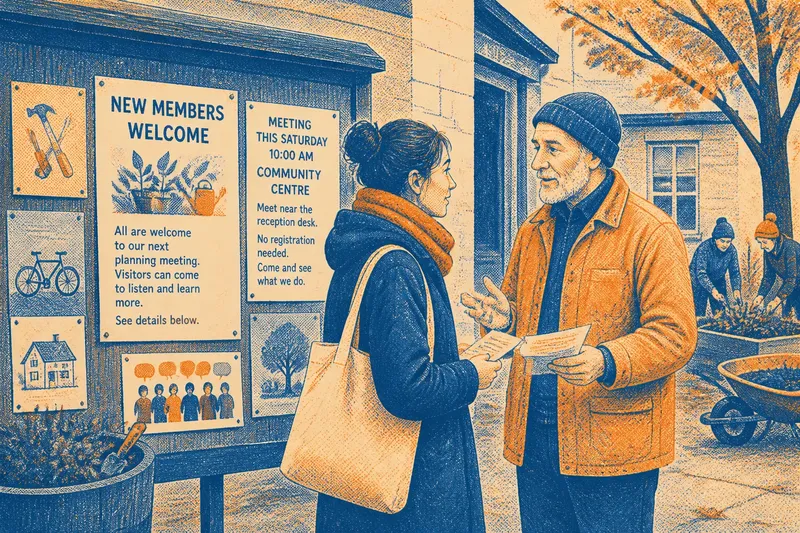
For example, imagine a neighborhood gardening group has posted only “New members welcome.” The organizer could clarify that visitors may attend the next planning meeting, meet near the community-center reception desk, and listen without taking on a task. A reader can then decide whether that kind of meeting suits them.
Make the next step visible and specific.
Personal invitations
A direct invitation can help someone hear about a group from a person they know. It can also explain why the group is contacting them and give them a simple way to ask questions. But if invitations circulate only among existing friends, residents outside those circles may never learn that they can join.
Keep personal invitations as one option, not the only route. A member might say, “I’d be glad to introduce you, and you can also come on your own; here are the meeting details.” Share the same public notice through different local channels, such as a library board, neighborhood association, or community newsletter.
Ask whether someone could find the group without already knowing a member. If not, add a public way to express interest.
Voluntary participation
Enthusiasm can sound like pressure if a visitor is told the group “really needs” them, asked to take a role immediately, or contacted repeatedly after declining. A prospective member may want to observe or learn more before deciding whether to help.
Explain what membership involves before someone signs up. Mention any regular attendance, forms, fees, or tasks that are expected. If none is required, say that too. Ask permission before adding someone to a mailing list or group chat, and accept a pause or refusal without asking for a reason.
A useful invitation leaves the decision with the person receiving it.
Clear expectations
People may expect a social gathering and arrive at a working meeting, or expect to contribute ideas and discover that the discussion is already focused on assigned tasks. Often, the group has described its purpose too broadly to show what participation looks like.
Use concrete language. Explain whether members plan activities, share information, maintain a resource, or discuss local concerns. Say whether a visitor can listen, ask questions, or suggest an idea. If responsibilities vary by role, describe the options and let people decide after they understand them.
A short, accurate description helps someone judge the fit before attending.
Choosing an invitation?
When does open sign-up work best?
Open sign-up works well when the group wants anyone interested to find the same route in, including people without an existing contact. Give clear meeting information and state whether visitors need to register.
When is a personal invitation useful?
A personal invitation can make the group’s purpose and next step easier to understand through a familiar contact. Present it as an option, not a condition of attendance.
Can a group offer both routes?
Yes. Keep public information available and let members offer a personal introduction when someone wants one. This gives prospective members a choice about how to make contact.
How should a group handle follow-up?
Ask before sending messages or adding a person to a group channel, and respect a request to wait or decline. A prospective member should not need to explain a decision.
Matching route to need
Choose the invitation around the information people lack. If the group is hard to discover, make the public notice easier to find and more specific. If someone has already expressed interest but wants to know more, offer a personal conversation or a written description of the meeting.
Say you coordinate a local repair group, and someone asks what joining means. You explain that the next meeting is open to visitors, that they can watch before taking part, and that regular members choose tasks together. The person says they would rather read the meeting details first, so you send the public notice and do not add them to the group chat. The result is a clear next step without assuming they have committed.
Open sign-up or personal invitation should help people understand how to make contact, what participation involves, and which choices remain theirs. A public route makes the group discoverable; a personal route can offer a direct conversation. Keeping both available lets prospective members decide which approach suits them.