How Neighborhood Groups Can Explain Their Unwritten Customs
Explain neighborhood group customs with a shared routine map that preserves useful traditions, clarifies decisions, and gives members a way to update them.
Why does a neighborhood group keep doing something nobody can explain? A group’s unwritten customs often begin as convenient habits, then persist because regulars know them by heart. Making those routines visible helps members decide which ones serve the group and which are ready to change.
Habits become customs
A community garden may put tools away in a particular order, or a neighborhood association may ask one member to read notes aloud before discussion. These practices can help people coordinate. But a habit becomes a custom when repetition makes it feel like the only proper way, even if the group never chose it deliberately.
That distinction matters. A useful routine has a reason members can explain: returning shared tools to one spot makes them easier to find, for instance. A routine that survives only because “we’ve always done it” may be harmless, but it deserves a fresh look.
Start by asking what the custom accomplishes, who benefits, and whether it creates unnecessary work or limits participation. The point is not to erase a group’s character; it is to keep tradition connected to purpose.
Map the routine
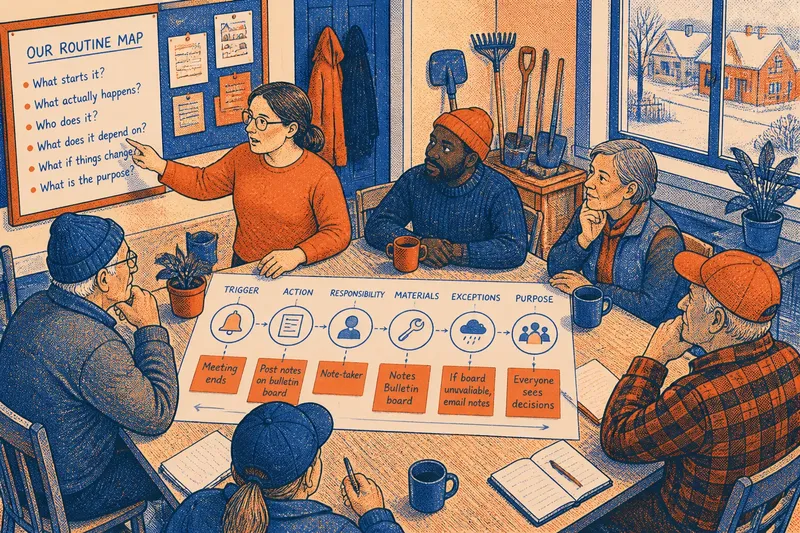
Choose one recurring practice and describe what actually happens, rather than what members think ought to happen. A short routine map can capture the trigger, the action, the person responsible, and the intended result. For example, “After the meeting, the note-taker posts decisions on the bulletin board so absent members can see them.”
- Trigger: Check what event or cue starts the custom. If members identify the same clear cue, keep it; if answers differ, agree on one signal or remove the ambiguity.
- Action: Check what people actually do. If the action supports the group’s purpose, explain it plainly; if it adds no useful result, consider dropping or simplifying it.
- Responsibility: Check whether everyone knows who handles the task. If a role is clear and manageable, retain it; if it falls unpredictably on one person, share or rotate it.
- Materials: Check which items the custom depends on, such as a sign-in sheet, key, or noticeboard. If the item is reliably available, name its location; if not, choose a simpler method.
- Exceptions: Check what happens when weather, attendance, or supplies change. If members can name a workable alternative, write it down; if not, agree on who decides in the moment.
- Purpose: Check what observable result the custom is meant to produce. If members agree on the result, compare the routine against it; if they cannot name one, consider retiring the custom.
Imagine a block association whose meeting notes are traditionally read aloud, but members disagree about why. Start with the actual inputs: the notes, the person who wrote them, the meeting room, and the members present. Ask what reading them accomplishes; if members say it lets everyone hear decisions, keep that purpose. Then check whether the same result can be reached by posting the notes on the room’s bulletin board and inviting questions. If members can read the posted version and correct errors together, adopt that routine; if some attendees need the notes read aloud, retain the reading and post a copy as well. The decision follows from the group’s purpose and the people present, not from the age of the custom.
Decide what stays
A routine map is useful only if members can act on it. At a meeting, separate customs that protect a shared resource or make coordination easier from those that are merely familiar. Then choose whether to keep, revise, or stop each one.
For a custom worth keeping, state its reason in a sentence. For one that needs revision, name the change and who will take responsibility. If the group decides to stop a practice, explain what will replace it—or confirm that nothing needs to replace it.
Write the decision where members will use it: meeting notes, a shared document, or a notice beside the relevant equipment. Keep the wording short enough to review when the custom comes up again.
Review customs together
Should a group review customs on a schedule? Review them when members notice recurring confusion, uneven workloads, or a mismatch between a routine and its purpose. A short discussion at an existing meeting is often enough; no separate committee is needed.
Who should take part?
Include the people who carry out the routine and those affected by its result. If a custom involves a shared room or resource, ask the people who use it what works and what creates friction.
What if members disagree?
Ask each person to name the purpose they think the custom serves, then look for a result they can agree on. If the disagreement remains, try a clearly described alternative at a later gathering and review whether it meets that purpose.
How should a change be recorded?
Put the decision, its reason, and the person responsible for any follow-up in the group’s usual record. If the change affects a regular task, post the revised routine where that task happens.
When should a custom end?
Consider ending it when members cannot identify a useful purpose, it creates avoidable burdens, or a simpler practice achieves the same result. If it protects something the group values, revise the routine instead of discarding that purpose.
Keep traditions useful
Some customs carry local memory as well as practical value. A group might open its annual clean-up by naming the neighbors who started it, then move on to the day’s work. Keeping that moment can honor the group’s history without requiring every part of the event to remain unchanged.
When a routine is revised, tell members what is changing and why. A note beside the shared tools or a clear line in meeting minutes can prevent the old pattern from quietly returning. Revisit the decision if the new approach creates a problem the group did not expect.
For neighborhood groups, a clear account of customs is not paperwork for its own sake; it is a way to preserve the practices people value and make deliberate choices about the rest. When the reason for a custom is easy to say, members can decide with care whether to keep it, adapt it, or let it go.