A Box of Minutes, a Board of Photographs: Choosing What a Group Keeps
Choosing what a community group keeps starts with a clear method for preserving decisions, photographs, and objects while keeping sensitive records secure and findable.
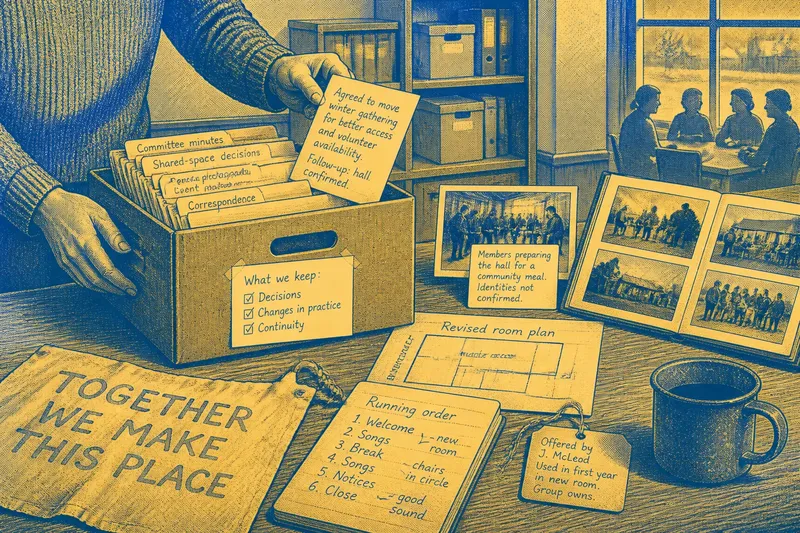
Which papers, photographs, and objects should a community group keep when its cupboard is already full? Choosing what a community group keeps is easier when each item is judged by what it explains: a shared decision, a change in practice, or the continuity of the group.
That rule is more useful than trying to save everything or judging an item by age alone. A faded notice may show how a decision was communicated; a newer note may explain why a long-running activity changed. The value lies in the connection an item makes visible.
Keep the decision trail
Minutes matter most when they record more than who attended. A compact account of the question considered, the decision reached, and any assigned follow-up can help a future committee understand what was agreed. The point is not to preserve every spoken comment. It is to keep enough context that a short entry does not become mysterious later.
For example, “The group agreed to move the winter gathering” leaves a gap. A record that says the change followed a discussion of access and volunteer availability gives later members a reason they can assess. Names may not be needed unless responsibility for a task or formal approval needs to be clear.
Keep the record of a decision alongside any document that gives it practical meaning: a revised room plan, an approved set of spending priorities, or a letter confirming a shared arrangement. If the supporting paper is bulky, retain the version that was actually considered or adopted rather than every draft.
Write a brief note beside an unusual decision while its context is still familiar.
Photographs need context
A photograph can document a place, a changing practice, or the people who made an activity possible. A board of unlabeled faces, however, can be difficult to use and may raise questions about privacy. Keep images that add something to the group’s record, then give each selected image a caption with the event or setting, an approximate time if known, and the source or contributor.
Do not guess at names. A caption such as “Members preparing the hall for a community meal; identities not confirmed” is more honest and useful than confident misidentification. If people are identifiable, consider the group’s consent arrangements and whether the image is meant for internal memory, public display, or both.
Choose a small set that shows a meaningful change or a distinctive activity rather than many near-identical frames. Keep the original files when available, and place captions in a separate file or collection record as well as on any display copy. A printed photograph can be labeled on an accompanying sleeve or card; avoid writing on the image itself.
One well-captioned image can say more than a crowded board.
Objects that explain continuity
Not every object needs a permanent place in the group’s collection. A hand-painted sign, a worn event banner, or a marked-up seating plan may matter because it shows how an activity was organized or how members adapted it. Ask what a future member could learn from the object that a written note or photograph would not explain as well.
Routine supplies and duplicate keepsakes are usually easier to replace than the story attached to them. If an object is kept, record who offered it, what it was used for, and whether the group owns it or is borrowing it. That simple description can prevent a meaningful item from becoming an unidentified parcel when officers change.
Say a neighbourhood choir has a handwritten running order from the first year it began meeting in a different room. Members might keep that annotated sheet with a short note explaining the move, while recycling clean copies that add no new information. The result is a record that shows both the practical change and the group’s response without turning every rehearsal paper into an archive.
What should a group keep?
Are all meeting minutes worth keeping?
Keep minutes that record decisions, delegated responsibilities, changes to the group’s purpose, or explanations likely to matter later. Routine notes can be brief, but avoid discarding records that document formal approvals or unresolved commitments.
Should a group keep every photograph?
No; select images that document people, places, or activities not already represented, and add captions that distinguish what is known from what is uncertain. Think separately about keeping an image and displaying it publicly.
What belongs in a group archive?
Keep records and objects that explain the group’s decisions, identity, or continuity, along with enough context to identify them. Personal information, ownership, and any applicable retention rules may affect what can be retained or shared.
How can new members understand old records?
Give the collection a short finding note that names its main folders or boxes and explains any unfamiliar terms. A future member should be able to locate a decision without already knowing who made it.
Make the collection findable
A modest collection is useful only if someone can tell what is in it. Use plain folder names such as “Committee minutes,” “Event photographs,” and “Shared-space decisions.” Add a simple index listing the item, its date or approximate period, where it is stored, and any access limits.
Keep digital files in a group-controlled location rather than relying on one member’s personal account. Use descriptive filenames, such as “Hall-access-decision-year-approximate,” and preserve original versions of important records. If the group makes a second copy, store it in a separate group-controlled account or encrypted drive, limit access to named members who need it for their roles, and protect it with strong passwords or account-level security. Review who has access when responsibilities change, and remove access when it is no longer needed. If the group cannot maintain those safeguards, do not place sensitive records in the second copy; ask an appropriate records professional about a secure arrangement. Avoid scattering the same document across chat threads, private drives, and unlabelled USB sticks.
For paper, store records in a dry, stable place away from food, damp, and direct sunlight. A labeled folder inside a sturdy box is often more useful than an elaborate system no one can maintain. If a record contains sensitive personal details, restrict access rather than placing it in a general display collection.
- Check whether a file has a clear, descriptive name; if it does, keep it, and if it does not, rename it before filing.
- Check whether an important digital record has an intact original version; if it does, retain that original unchanged, and if it does not, identify the best available copy and note that it is a copy.
- Check whether a proposed second copy contains sensitive details; if it does, use only a separately stored, access-restricted group-controlled location, and if that cannot be arranged, keep the record out of that copy and seek suitable records advice.
- Check whether each person with access needs the record for a current role; if they do, retain their access, and if they do not, remove it or narrow permissions.
- Check whether the index states where the item is stored and any access limits; if it does, file the item there, and if it does not, update the index before another member needs to find it.
- Check paper records for signs of damp, food exposure, or direct sunlight; if any are present, move the folder to a dry, stable storage place, and if none are present, leave it in its labeled box.
Imagine a small hall committee has minutes about a room-access decision and a scan containing a member’s contact details. The minutes are named “Hall-access-decision-year-approximate” and kept in a group-controlled folder; the scan is not placed in a broadly accessible backup. The committee stores the scan’s separate copy in an encrypted group-controlled drive, grants access only to the two current officers responsible for records, and notes that restriction in the index. When one officer’s role ends, the committee removes that account’s access. The records remain findable to the people who need them, while the contact details are not exposed to the wider membership.
Agree on a small policy
A short retention note can help members make consistent choices without creating a formal archive department. It should say who may approve additions, where records belong, how images are handled, and when the group reviews material that no longer serves a clear purpose. State that personal or confidential information is treated separately, including who may access it and how access changes when officers leave.
Where the right decision depends on a document’s label, the creator’s instructions, or local rules, check those requirements and ask a qualified records professional where needed. For ordinary group material, the guiding question remains straightforward: does this item help explain a shared choice or the group’s continuity?
Keep that question with the box and the photograph board. It helps incoming members understand why a record is preserved, while making it easier to let go of duplicates that add no further context. Choosing what a community group keeps also means deciding carefully who can see the records that remain.